 Two new working papers are available on the website of the Lessons Learned Consortium of the Contact Group on Piracy of the Coast of Somalia. The first one authored by William Smith of Chinese University Hong Kong evaluates the work of the Contact Group in the light of the discussions on legitimacy. The second one authored by myself asks how the internal lessons of the CGPCS can be used to improve coordination for capacity-building in the new Contact Group structure.
Category Archives: News
Why the fight against Somali piracy isn’t over yet
In a new short contribution to The Georgetown Journal of International Affairs, I discuss the reasons for the decline of Somali piracy and why continuous efforts in counter-piracy will be necessary. I argue that the focus on capacity-building of the CGPCS is important, but requires sustained attention. Read the contribution here.
First Maritime Security Summer School great success
The Olympia Summer Academy provided the framework for the first summer school in maritime security (18-22.7.2014). The summer school organized by Cardiff University and piracy-studies.org brought together 12 students from across the world to discuss different aspects of maritime security and the future challenges for research. The summer school was taught by two academics (Dr. Christian Bueger, Cardiff University and Prof. Harry Papasotiriou, Pantheon University Athens) and one practitioner (Capt. Hartmut Hesse, former IMO special representative). The sessions focused on the concept of maritime security, theoretical perspectives on maritime security, naval strategy, the law of the sea, the work of the International Maritime Organization, an in-depth analysis of maritime piracy, and the challenges of maritime capacity building. The discussion revealed the many gaps in research and analysis that the young field of maritime security studies has still to fill. Especially the role of civil actors, capacity building, and new approaches to managing the complexity of maritime security requires more academic attention. The new generation of scholars in the field will play a vital role in this.
Political Methodologies in Practice – A Doctoral Training Workshop
This week we held a Doctoral Training Workshop in Cardiff. The focus was on questions of methodology, methods and skills. In the workshop we blended different discussion formats. Since methodology is always about experimenting and trying things out, we were experimenting with new formats. These helped us to match the needs of the participants with the expertise of the staff, and sparked a range of discussions of interest to everyone. In a methodology workshop we discussed the projects of participants in smaller groups clustered around the themes of reflexive/interpretive, comparative, and philosophical methodology. In a methods cafe, we hosted tables for open discussion on a range of methods, including interviewing, participant observation, large-n analysis, and discourse analysis. In three roundtables, we discussed publishing, grant funding and career choices. Professor Jef Huysmans from Open University gave one of the keynote talks. In his talk titled “Methodological Acts” he outlined that methods need to be understood as complex practices which have political effects and perform the world in distinct ways.
In the Field: The African Union and its Maritime Strategy

African Union building
The African Union is increasingly become a lead actor in African Maritime Security. With the conclusion of the African Integrated Maritime Strategy (AIMS) the core challenge is now to implement the ambitious project of strengthening Africa’s blue economy and addressing maritime instability. To discuss the implementation and how the international community can assist the AU, I am travelling to Addis Ababa from the 12th to the 18th of June, for a range of consultations and conversations. I am also attending a workshop organized by the Friedrich Ebert Foundation on the 16th and 17th which deals with the same manner. The workshop titled “African Approaches to Maritime Security: The AU and Continental Perspective” includes contributions by a range of African maritime security scholars and aims at evaluating the state of maritime security on the continent and identifying priorities.
New Blog on Piracy and Technology
A new blog post summarizing the results of last weeks workshop on piracy and technology is available at piracy-studies.org. The blog sketches out the dimensions that require consideration in the development and use of technology in the fight against piracy.
Political Methodologies in Practice.
At Cardiff we are organizing a Joint Doctoral Training Workshop of the Wales DTC, July 2-4, 2014. This three-day event is hosted by Cardiff University and brings together two distinct but complementary Wales DTC pathways: Conflict, Security and Justice (day one) and Language-Based Area Studies (day three). The second day is mainly devoted to core inter-disciplinary issues that are of relevant to postgraduate students in both pathways. This innovative workshop is open to all postgraduate research students in Wales and (at a nominal charge of £25) to all ESRC-funded students throughout the UK.
The workshop will include over 20 speakers from staff and students at Cardiff, Aberystwyth and Swansea Universities. Keynote lectures will be given by Professor Jef Huysmans (OpenUniversity) on ‘Methodological Acts’ and Professor Alistair Cole (Cardiff University) on ‘The Past, Present and Future of Language Based Area Studies’. Speakers and workshop leaders include David Boucher, David Bewley-Taylor, Rob Bideleux, Berit Bliesemann de Guevara, Jonathon Bradbury, Christian Bueger, Gerard Clarke, Gordon Cumming, Andrew Dowling, Mark Evans, Paul Furlong, Inanna Hamati-Ataya, Nick Parsons, Roger Scully, Ian Stafford, Peter Sutch, Elisa Wynn-Hughes, and Matthew Wall. Continue reading
Technology and Piracy
 What role does technology play in the fight against Somali piracy? What future prospects lie in different technologies to curb and prevent piracy in the long run? What new regulatory challenges arise? These are the question a workshop hosted by the Copenhagen Business School and organized by the Center for the Resolution of International Conflict and the Counter-Piracy Governance Project addresses. The one day workshop titled “Technological Solutions to the Piracy Problem? Challengers Ahead and Lessons Learned from the Horn of Africa” brings together different stakeholders, including different maritime security agencies, the shipping industry, maritime lawyers and maritime security scholars together to discuss the prospect and risks of a technologization of piracy.
Joint EISA Workshops in Izmir
The European International Studies Association (EISA) the successor of the Standing Group of International Relation (SGIR) of the ECPR has a new meeting format: joint workshops that take place in one location. This year’s is the second installment and takes place in Izmir, Turkey. At the event we have organized a workshop that discusses how approaches from sociology of science can shed new light on international relations problems and the discipline. The workshop is titled “Practices of Knowledge-Generation and Mobilization in International Relations” and jointly organized with Gerard van der Ree (Utrecht University) and Félix Grenier (University of Ottawa). I am attending from the 22nd of May and will be presenting two papers, one is the forthcoming paper on epistemic practices and the translation of piracy, the other one the paper co-authored with Felix Bethke, that investigates in how far IR is a discipline driven by “fashions” rather than rational progress. A detailed description of the workshop is available here.
CAST’s Translations of Security Conference in Copenhagen
From the 20th to the 21st of May I am attending the conference “Translations of Security: Changing social understandings of threats, risks and dangers” which marks the significant achievements of the Center for Advanced Security Theory (CAST) of the University of Copenhagen in the field of security studies. The three day event brings together a range of prominent security thinkers and especially foregrounds the exchange with other disciplines as well as practice. This is how the organizers sum up the conference theme
In contemporary security, an increasingly wide range of agencies, organizations and businesses play a central role in defining security policy and security political knowledge. This ‘diffusion’ of security knowledge and management changes the mere meaning of our concepts and practices of security – what is at stake in the processing of threats, risks, dangers and security.
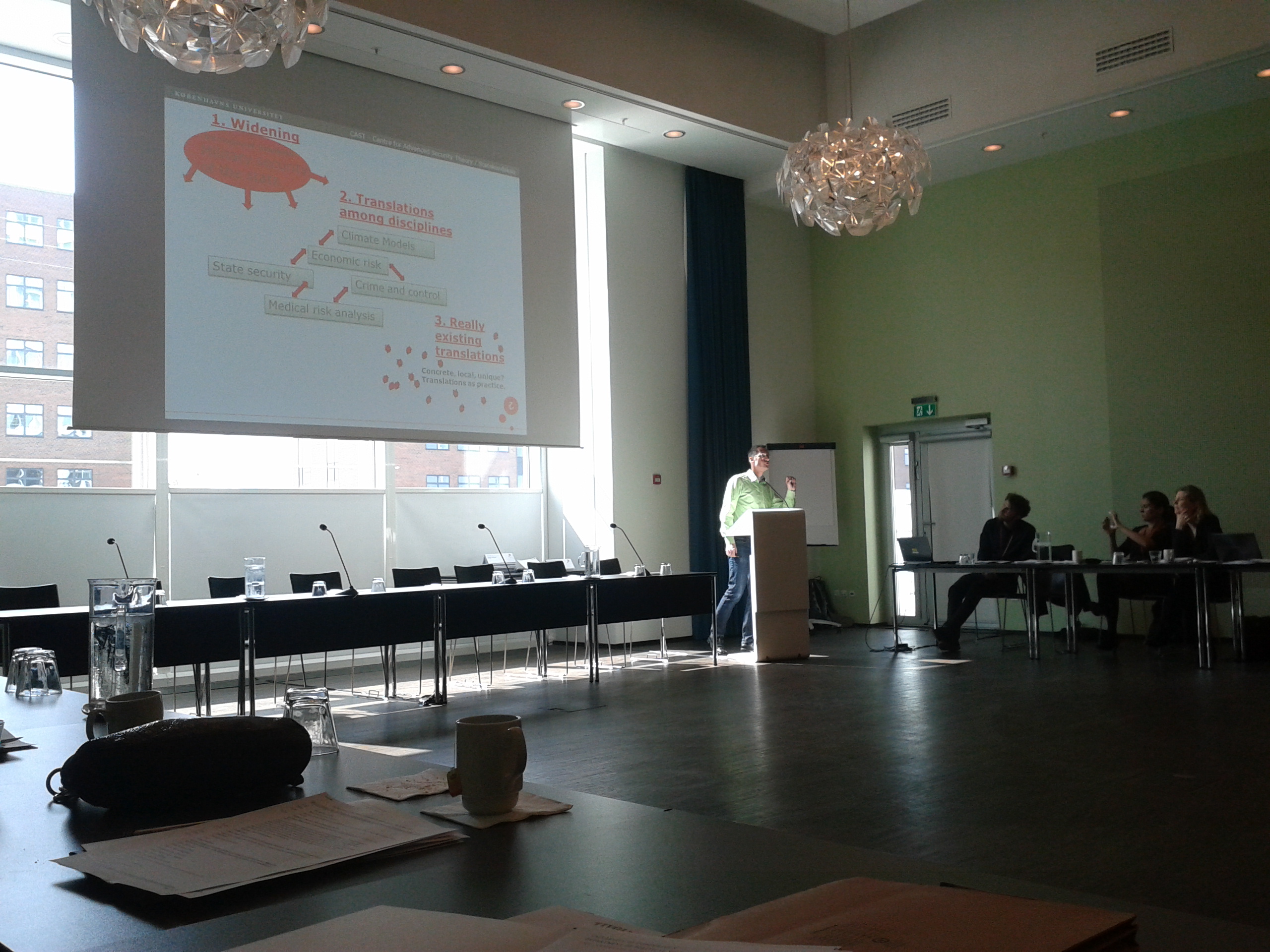
Ole Waever discussing the evolution of security theory at CAST conference
The conference will take ‘new security studies’ beyond the established theoretical debates and schools and ask questions to translation of security across disciplines and in practice. In theoretical and empirical terms it will address how meetings between different fields of practice continually challenge, modify or maintain social understandings of security threats, risks and dangers.
At the conference we will thereby attempt to think security beyond securitizations and not focus on how different sectors or fields increasingly incorporate one specific security logic (securitization). Instead, this conference will draw attention to how different spheres, organizations, and cultures manage threats and what happens when objects or issues move among and across these.