From the 12th to the 14th of June I am scheduled for Brussels. On the agenda is first a briefing at NATO HQ on the upcoming NATO Summit. I am in particular interested how NATO will continue its maritime security work. 2016 is a transformative year, it is expected that NATO’s Operation Ocean Shields will end this year, there is a growing discussion of what NATO’s role could be in tackling the human trafficking problem in the Mediterranean and how such work could be linked to Operation Active Endeavour, and the opreationalization of the Alliance Maritime Strategy still lack progress. On the second day I am acting as reviewer for an European Commission funded FP7 project. The project titled IPATCH intends to develop early detection mechanisms for piracy and as such might assist in strengthening maritime domain awareness.
Bridging the Gap
 From June 5th to the 9th I will participate in the International Policy Summer Institute (IPSI) of the Bridging the Gap Project. Held in Washington the program intends to explore ways of how to better connect research and policy in the field of international affairs.
CGPCS Plenary Meeting in the Seychelles
 The Contact Group on Piracy off the Coast of Somalia – the global governance body which I have been studying closely in my ESRC funded Counter-Piracy Governance project – is soon to hold its next plenary meeting. Organized by the current chairmen, the Government of Seychelles, the four day meeting will be held in the Seychelles from the 29th to the 3rd of June. I will be participating as an observer, but also give two presentations during the meeting. In the first presentation I will provide an update of the lessons learned work I have been doing for the group, and in the second discuss the future of the group on the basis of a recent paper. I will report on the event on the website of the group which is available here.
Participants in the Maritime Domain Awareness Ideaslab
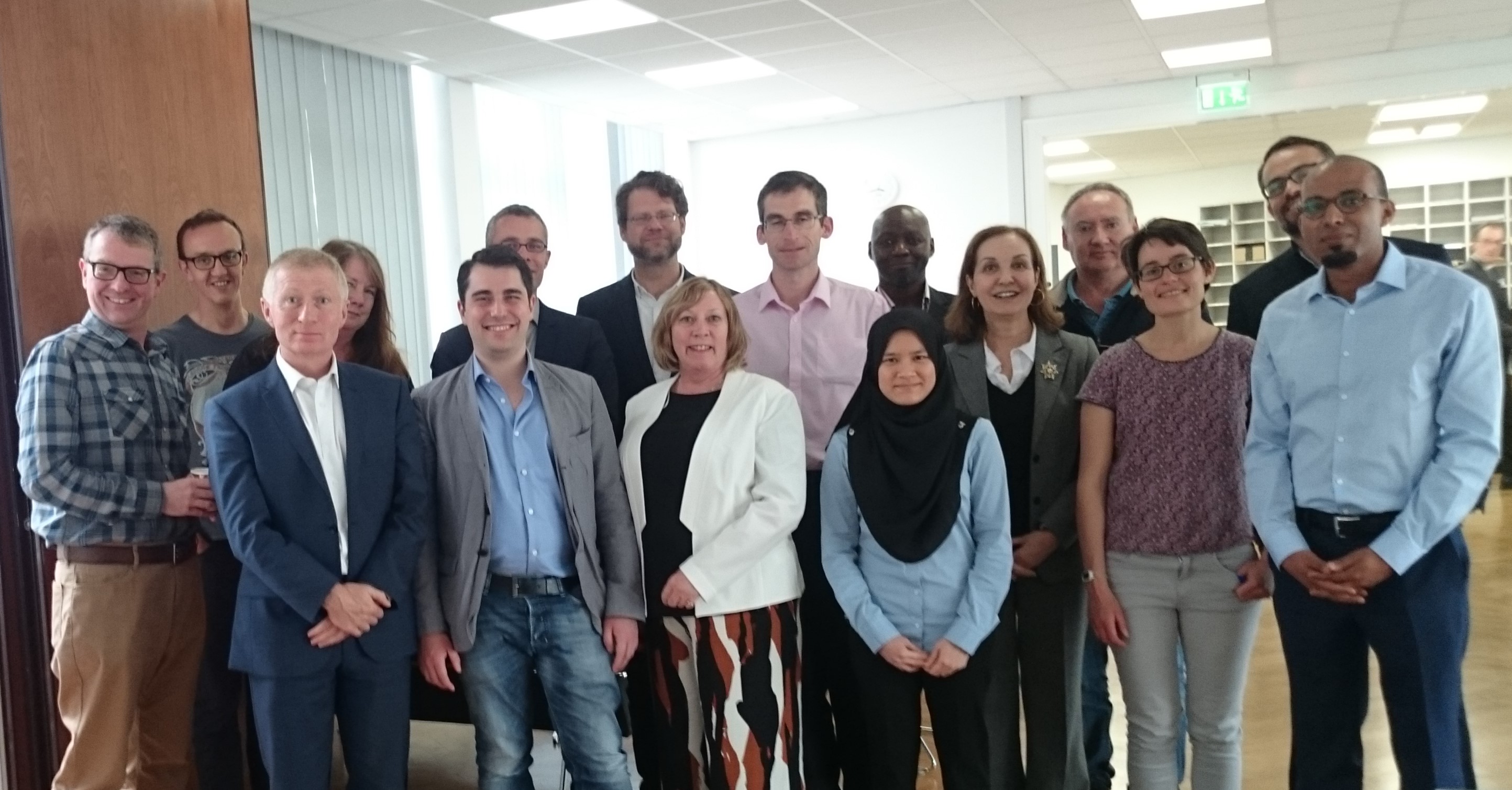
Participants in the Maritime Domain Awareness Ideaslab
Knowing the Sea. Ideaslab in Cardiff to celebrate EU Maritime Day
 How do we know the sea? This question is not only important for enhancing the public understanding of the sea, it is vital for how we govern the littorals, Exclusive Economic Zones and the global oceans. In an ideaslab, held on the 20th of May in conjunction with the EU’s European Maritime Day we will discuss Maritime Domain Awareness as one attempt to understand the sea.
Ever since humans have started to harvest ocean resources and sailed on the sea, knowledge of the sea has been vital to do so. Advancements in science and technology have been vital to establish new ways of governing oceans. A case in point is the British Empire, which has long served as the steward of the global oceans. As Michael Reid has shown, the British Empire was dependent on and only possible by advancements in ocean science which allowed for efficient navigation. “The British Admirality, maritime community, and scientific elite collaborated to bring order to the world’s seas”.
Today, the order of the sea looks very different. On the one hand, since the late 1980s, the establishment of UNCLOS and related regimes have done much to embed commonly agreed norms and practices of political order at sea, whether in relation to maritime stewardship or the free passage of commerce and the demarcation of territorial waters and other maritime zones.[4] On the other hand, the degradation of ocean health, rising inter-state tensions in areas such as the Arctic or South China Sea, and the emergence of new maritime insecurities, such as piracy, people smuggling or fishery crimes, present significant challenges. For many this leads to the conclusion, that we are facing a “new anarchy” at sea.[5] Whether one shares the optimistic or pessimistic viewpoint, the is little doubt that pursuing the goals as they are expressed in the agendas of ‘ocean health’, ‘blue economy’ or ‘maritime security’ will require better ocean governance. Given the close link between knowledge and governance, this implies to pay close attention of how science, technology and knowledge production of the sea can be advanced. Continue reading
Understanding the Maritime Security Agenda
What are the implications of the maritime security agenda for how the oceans are governed? And what can we learn about international order and change? These are the questions I explore in a new draft paper co-authored with Tim Edmunds (Bristol University). We will present and discuss the paper in the Work In Progress Seminar Series of the International Studies Research Unit of the Department. The discussion takes place on the 18th of May, 4.00-5.30, Park Place 32. Here’s the abstract of the paper (contact me for a copy by email):
The question of when and how international orders change remains a pertinent issue of international relations theory. In this article the rise of the new maritime security agenda provides us with an exemplary case for how new orders emerge. Investigating the evolution of maritime security and the diverse responses to it, we develop the concept of pragmatic orders. Pragmatic orders emerge in response to new problem spaces and are primarily driven by informal practical activities geared at coping with and governing these spaces. Outlining this approach we detail core characteristics of maritime security and study four elements of it, that is, maritime security strategies, new forms of governance, the episteme of maritime security and the role of capacity building projects. The article draws attention to the fundamental reorganization of maritime space occurring over the past decade, and offers an innovative new approach on how to study orders and change.
Workshop on Practices in Edinburgh
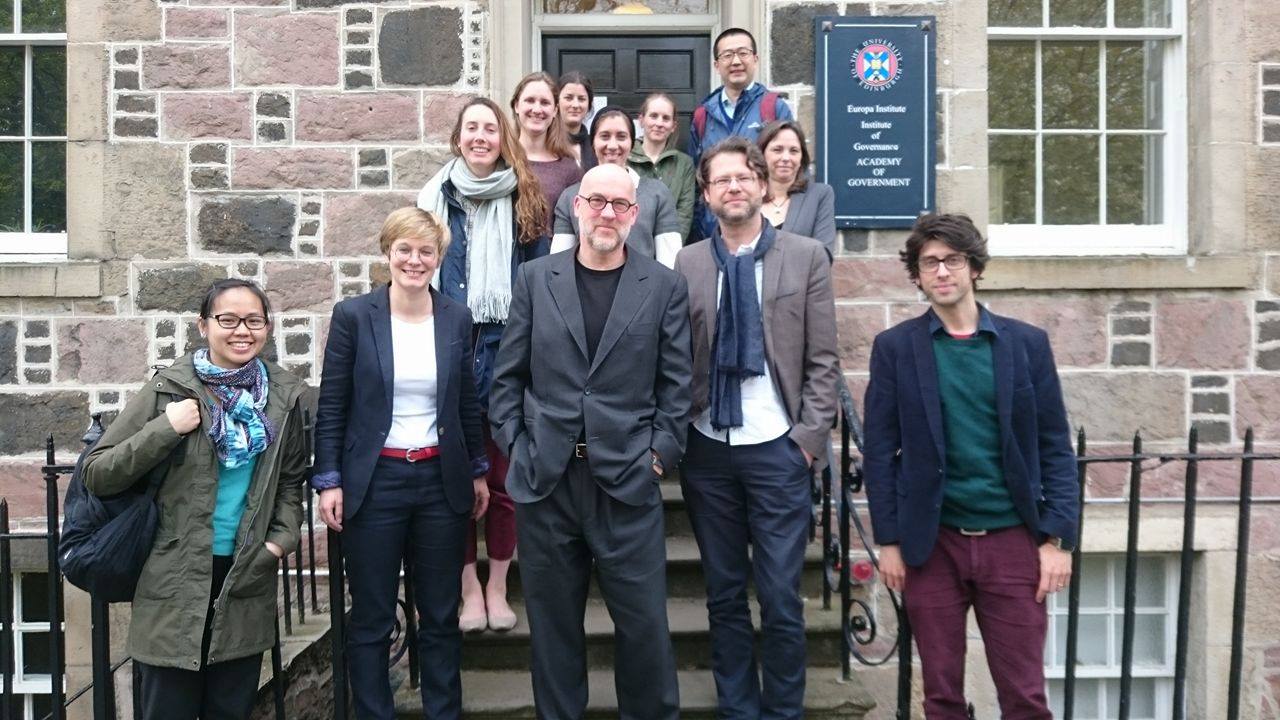 “Politics on a Human Scale: Approaches to Practice in Policy, Politics and IR” was the title of a workshop jointly organized between the University of Edinburgh’s Centre for Security Research, its Academy of Government and Cardiff University’s Department of Politics and International Relations. The workshop, held on the 6th of May, focussed on ongoing research projects which aim at zooming in on activities and practices of politics. The workshop discussions centred around different approaches to practice in our research with a view to rethink the theory-methods package in studies of practice. What are the implications of drawing on certain concepts for methodology and research practices? How do we relate research practices to attempts of generalising and abstracting? The workshop was a very productive environment to address these questions. From Cardiff, Alena Drieschova, Hannah Hughes and myself participated in the event.
I gave talk on my ongoing counter-piracy governance project, particularly developing the methodological reasoning. I discussed what we might learn from alchemism and their interest in the occult and experimentation. Arguing that alchemism revolves around three core concepts – expertise, experiment, experience – I outlined how these can organize a research process and our thinking about it.
Given the shared research interest of both universities in the field of practice research, but also areas of research such as devolution, we intend to institutionalize Cardiff-Edinburgh research meetings in the future.
Whatever happened to the Somali Pirates? Talk @ Edinburgh
On May, the 5th, I will be giving a talk at the Centre for Security Research at the University of Edinburgh. In the talk I revisit the rise and fall of Somali piracy. The first part investigates how we can explain the emergence of piracy, by paying attention to structural and agency oriented arguments, as well as the known set of factors that trigger piracy. The second part investigates the building blocks of counter-piracy and why these were so successful. I pay particular attend to legal and military coordination and the role of the Contact Group on Piracy off the Coast of Somalia in steering the development of these processes. I end with an outline of what the policy consequences of this story are, and what the broader lessons for the debates in global security governance. Further info on the talk is available here.
New Voices in Piracy Studies: Workshop @ Cardiff
Next week (28-29th of April), I will be hosting a small workshop on current research on piracy and maritime security. The workshop titled “New Voices in Piracy Studies” brings together 10 junior researchers from across Europe working on projects in the field. In addition Dr. Marcus Houben (former head of the support team for the EEAS presidency of the Contact Group on Piracy off the Coast of Somalia) and Dr. Anja Shortland (Kings College) will give keynotes and act as discussants in the debate.
The background for the event is that piracy off the coast of Somalia is contained, but not eradicated. West Africa and Southeast Asia continue to see high levels of piracy. Piracy studies has emerged over the last decade as a trans-disciplinary project that is geared at theorizing and understanding the phenomenon of piracy as well as studying the institutional responses to it. As a field piracy studies is linked to various other concerns, such as those in maritime security, criminology, or global governance. At the event we will discuss ongoing research on contemporary piracy and the responses to it, as well as related maritime security issues. The workshop aims at addressing three particular questions, that is,
1) To identify the gaps in our understanding of piracy (and maritime security threats) and the response to it
2) To outline how studies of piracy can contribute to the wider debates in maritime security, international security, international relations or international law
3) To discuss how research can contribute to the policy discussion on the responses to piracy and other maritime security challenges.
Talk on Political Life of Documents
 Documents are the main material of international politics. Yet, scant attention has been paid to how to analyze them. In an upcoming talk I will draw on my ethnographic research on the Contact group on Piracy off the Coast of Somalia (CGPCS) to argue that we should pay more attention to the practical logic of documents, that is, how they are actually produced. I revisit the main forms of document analysis and then provide a discussion of the production of the CGPCS’ main document, its so-called “communique”. I shall show how what the CGPCS does and how it works can be understood by paying close attention to this production process. The talk is part of the research seminar series of the School of Law and Politics. It takes place 13th April 2016 @ 1:00pm, 1.28, Law Building, Museum Avenue, Cardiff. All welcome.