 What can the History of Intellectual Thought contribute to International Relations theory? Clarifying the relation between both projects was the objective of the Annual Political Theory Symposium of the Department of Political Science of the National University of Singapore (NUS). The symposium held on the 19th and 20th of March, brought together a range of key thinkers in the History of International Thought. There was some thought provoking insights for the Sociology of International Relations, too. Continue reading
Category Archives: News
Regional information sharing II: A visit to the ReCAAP ISC
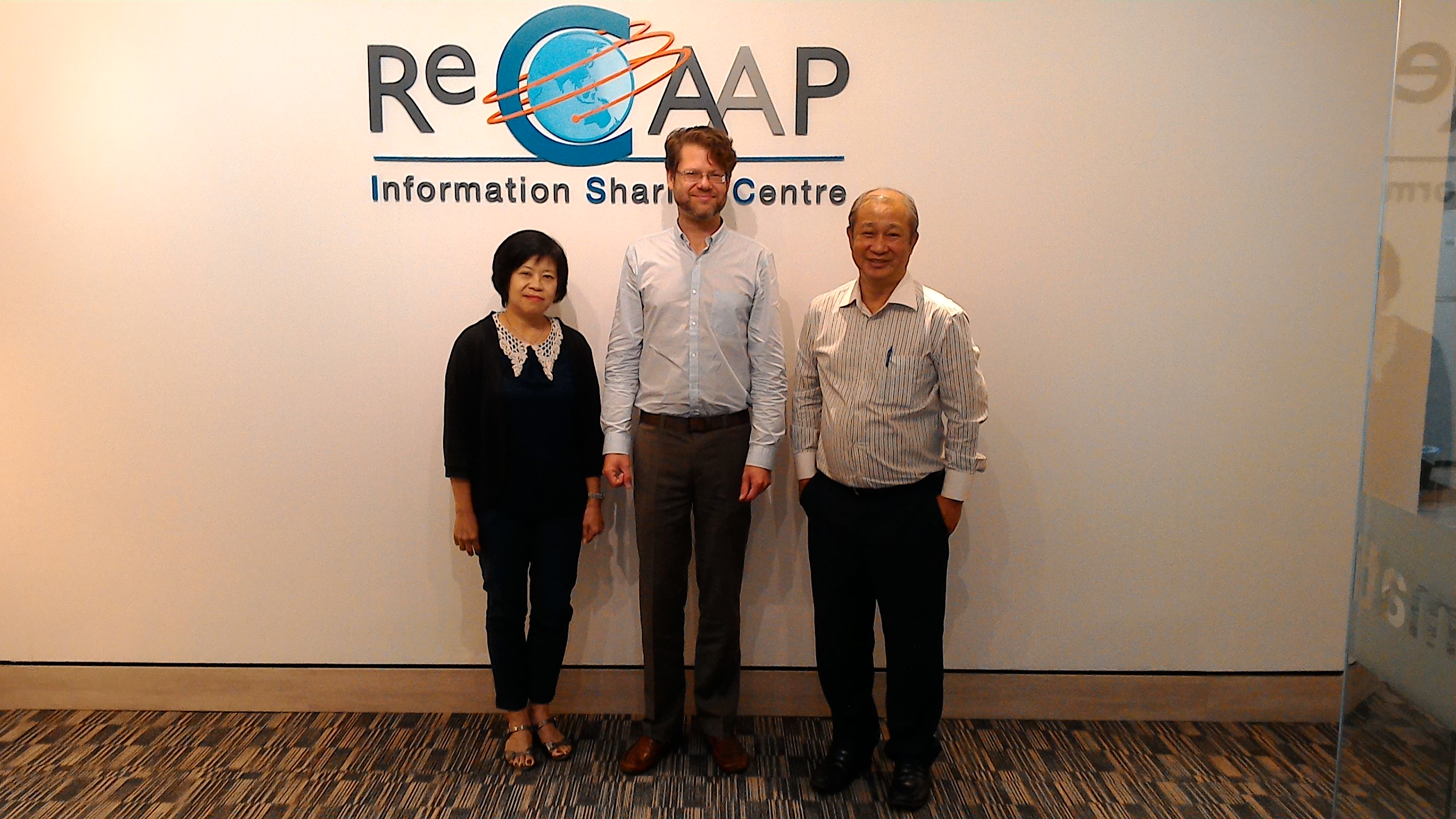 Following my recent visit to the IFC, this week I also had the pleasure to visit the second of the “big three” Information Sharing and Reporting Centres of South East Asia: the Information Sharing Centre of the Regional Cooperation Agreement on Combating Piracy and Armed Robbery (ReCAAP ISC). The ISC was launched in November 2006, and is hence the second oldest centre devoted to piracy (after the Piracy Reporting Centre of the International Maritime Board, IMB PRC). The basis of the centre is a formal multi-lateral (government-to-government) agreement finalized in November 2004 which came into force in 2006. In comparison to IFC, it is hence a more formalized and institutionalized form of cooperation which includes a governing council which steers the work of the ISC. ReCAAP has become a major role model for agreements in other areas, including the 2010 Djibouti Code of Conduct (DCoC) in the Western Indian Ocean and the more recent Yaounde Code of Conduct (YCoC) operating in the Gulf of Guinea. ReCAAP has 19 “Contracting Parties” which includes the East Asian literals, but also a range of European states (Denmark, Netherlands, Norway, UK) and Australia, Japan and the US. Continue reading
Article on Epistemic Practices, the UN and Knowledge Production on Piracy published
 My article titled “Making Things Known. Epistemic Practices, the United Nations and the Translation of Piracy” which has been in the pipeline for a while has now been published in International Political Sociology. The article has two core objectives:Firstly, to develop an appropriate theoretical framework on the basis of practice theory by which we can study knowledge production in international relations. My basis is here Karin Knorr Cetina’s practice theory as well as considerations from Actor-Network Theory. Secondly, to provide an initial empirical investigation of different types of knowledge production in the United Nations system. Drawing on the case of how piracy is made known for the UN Security Council I document three types of epistemic practices: the Quantification work of the International Maritime Organization, the detective work of a Monitoring Group, and the net-work of a special adviser. I hope that the article will spur some further discussion on variants of practice theory and what to do with it in IR, as well as how the UN works as a knowledge production organization. It is hence of interest in the debates on IR theory, as well as International Organization.
The article is available as open access in International Political Sociology 9(1).
Contact Group website under new management
 As part of my ESRC funded Counter-Piracy Governance Project [ES/K008358/1] we have been selected to take over the management of the website and document archive of the Contact Group on Piracy off the Coast of Somalia (CGPCS). The CGPCS is a global governance mechanism that was created to better coordinate the response to piracy off the coast of Somalia. Over 60 states, international organizations, NGO’s and the transport industry participate in this international organization to develop shared and coordinated responses to piracy. In the project we works with the CGPCS participants since 2014 in a lessons learned exercise. Managing the website and archive is a unique opportunity to study the work of an informal governance mechanism in great detail. We hope to be able to make the archive publicly available as soon as possible. The lessons learned project, the archive and the website of the CGPCS are available at the following address: www.lessonsfrompiracy.net
Counter-Piracy – Asian Style
To complement my research on responses to maritime piracy and to conduct a cross-regional comparison I will spend the next couple of weeks in Singapore and also visit Malaysia. The National University of Singapore’s Centre for International Law kindly invited me as a visiting fellow and will provide me with an institutional home. During my stay I will not only consult with fellow piracy experts and IR theorists, but also visit a range of information sharing centers and some of the core actors fighting piracy in the region. My goal is to compare and contrast how counter-piracy is organized in East Asia with the counter-piracy architecture in the Western Indian Ocean. The questions are: how can both regions learn from each other? What lessons does counter-piracy in the Western Indian Ocean have for South East Asia? In how far can South East Asia and mechanisms such as ReCAAP, IFC, or IMB-ISC be role models for the future of counter-piracy elsewhere?
EJIS: New BISA / Cambridge UP Journal on Security
 At this years conference of the International Studies Association the first meeting of the Editorial Board of the new European Journal of International Security was held. The journal is a collaboration between the British International Studies Association and Cambridge University Press. The editorial team, led by Professor Tim Edmunds, is comprised of researchers from the Great Western Four alliance. The journal will published from 2016 cutting edge security research. The journal focuses on making connections between different styles of reasoning and methods, between theory and policy, problems and solutions, critique and innovation. The journal accepts submission of papers up to a total length of 12.000 words. More information on the journal is available at the Cambridge University Press website as well soon under ejis.eu . As an Associate Editor of the journal I am happy to answer any questions. Follow the new journal on twitter here.
ISA conference in New Orleans – The discipline meets
From the 16th to 22nd of February I will be attending the annual convention of the International Studies Association in New Orleans. At this years event my focus is mainly on theory and methodology. At a pre-conference workshop on Conflict Expertise organized by Copenhagen University’s Center for the Resolution of International Conflict I will present my work on the epistemic practices of contemporary piracy. At the conference itself I am giving three presentations: One presentation is on the sociology of the discipline of IR (WB57) and criticizes the prevailing emphasis on community as category of analysis. The second presentation deals with International Practice Theory (FB13). I ask what understanding of “theory” we might gain from the practice turn and in how far experimentalist reasoning provides new avenues for research. The final presentation (with Peer Schouten) is on the relevance of John Dewey for International Relations Theory (SD31). I introduce a forthcoming book chapter which is presented as a virtual interview with Dewey. Like in the last years, I am also participating in a Methods Cafe (TB02), where we will discuss the methodological consequences of the practice turn in IR.
Learning from Piracy – Article Published
 As part of the first issue of the new journal Global Affairs my article “Learning from Piracy. Lessons for Maritime Security Governance” has been published. The article is available as open access here. In the article I investigate the causes of piracy and discuss how to interpret the current decline of Somali piracy against this backdrop. I conclude in outlining what can be learned from Somali piracy for broader questions of maritime security governance.
Briefing on Lessons Learned to NATO
The results of the Lessons Learned Project of the Contact Group on Piracy off the Coast of Somalia continues to attract wide interest. On January, 29th, I gave a briefing on the general lessons of the CGPCS for operations to NATO’s Operations Policy Committee. In the briefing I notably stressed the future role that experimental security governance systems can play, the potential of multi-layered approaches and the importance of day-to-day coordination to enable a culture of trust and confidence. I suggested that piracy is a powerful reminder of how vulnerable the backbone of globalization, the international sea, is. If the challenge of the 1990s was how to deal with the new wars, and the challenge of the 2000s was how to respond to international terrorism, the challenge of this decade is how to respond to maritime insecurity. In consequence, more energy is required for understanding the implications of the new maritime security agenda for international security. Please find the full text of the briefing here.
Call for Papers on Maritime Security
 Maritime security is an issue area of increasing importance in international relations and maritime security studies has emerged as a cross-disciplinary field of study in response. Following up on a series of successful maritime security studies meetings held in Cardiff, Coventry, Frankfurt and Geneva throughout 2014, a meeting will be held in the form of a section of the Pan European Conference of the European International Studies Association (EISA) in September 2015.
Maritime security is perhaps the latest addition to the international security vocabulary. Several security actors, including NATO, the EU, the AU and the UK have launched maritime security strategies recently demonstrating the salience of the theme. At the same time security studies is gradually discovering the importance of the maritime dimension and researchers from around the world have launched investigations of security at sea that go beyond the traditional concerns with naval strategy and history. The meeting seeks to bring together academics and analysts working on issues of relevance to maritime security. The aim is to discuss a range of emerging themes related to maritime security, including piracy, maritime crime, human trafficking, illegal fishing, boundary disputes, blue economy, marine safety, port security, maritime security sector reform or ocean governance. The objective will be to build cross-disciplinary connections between security studies, international law, international relations and maritime studies more broadly.
We welcome submissions on any topic associated with the section, with a particular interest in the following themes:
• Contemporary Maritime Piracy
• Transport and Port security
• The Maritime Dimension of Organized Crime (Human Trafficking, Smuggling, etc.)
• Maritime Security Strategies
• Naval Strategy and Naval Power
• Maritime Security Sector Reform, Capacity Building and the Security-Development Nexus
• Illegal and Unregulated Fishing
• Non-state actors in maritime security
• Ocean Governance and Blue Growth
• Theorizing the maritime as a security space
Both individual paper proposals, and panel/roundtable proposals are welcome. Each 105-minute panel/roundtable will comprise of up to five papers/presenters plus a discussant who will also act as panel/roundtable chair.
Proposals (with abstracts of 200 words maximum) must be submitted between 8 December 2014 and 15 January 2015 (by midnight CET), via the online submission system.
Please note that there will be a participation limit of three contributions per participant — whether as paper giver, roundtable speaker, or discussant/chair (any of these roles counts as one contribution).
The conference takes place on the 23-26.9.2015 in Giardini Naxos, Sicily, Italy. Further information on the conference logistics is available at: http://www.paneuropeanconference.org/2015/
If you have any questions about the section or would like to discuss your potential contributions please do not hesitate to contact either Chair:
Christian Bueger (buegercm@cardiff.ac.uk)
James A. Malcolm (james.malcolm@coventry.ac.uk)
Conference queries should be directed to the organisers at: paneuroconf2015@gmail.com