The European International Studies Association (EISA) the successor of the Standing Group of International Relation (SGIR) of the ECPR has a new meeting format: joint workshops that take place in one location. This year’s is the second installment and takes place in Izmir, Turkey. At the event we have organized a workshop that discusses how approaches from sociology of science can shed new light on international relations problems and the discipline. The workshop is titled “Practices of Knowledge-Generation and Mobilization in International Relations” and jointly organized with Gerard van der Ree (Utrecht University) and Félix Grenier (University of Ottawa). I am attending from the 22nd of May and will be presenting two papers, one is the forthcoming paper on epistemic practices and the translation of piracy, the other one the paper co-authored with Felix Bethke, that investigates in how far IR is a discipline driven by “fashions” rather than rational progress. A detailed description of the workshop is available here.
Category Archives: News

CAST’s Translations of Security Conference in Copenhagen
From the 20th to the 21st of May I am attending the conference “Translations of Security: Changing social understandings of threats, risks and dangers” which marks the significant achievements of the Center for Advanced Security Theory (CAST) of the University of Copenhagen in the field of security studies. The three day event brings together a range of prominent security thinkers and especially foregrounds the exchange with other disciplines as well as practice. This is how the organizers sum up the conference theme
In contemporary security, an increasingly wide range of agencies, organizations and businesses play a central role in defining security policy and security political knowledge. This ‘diffusion’ of security knowledge and management changes the mere meaning of our concepts and practices of security – what is at stake in the processing of threats, risks, dangers and security.
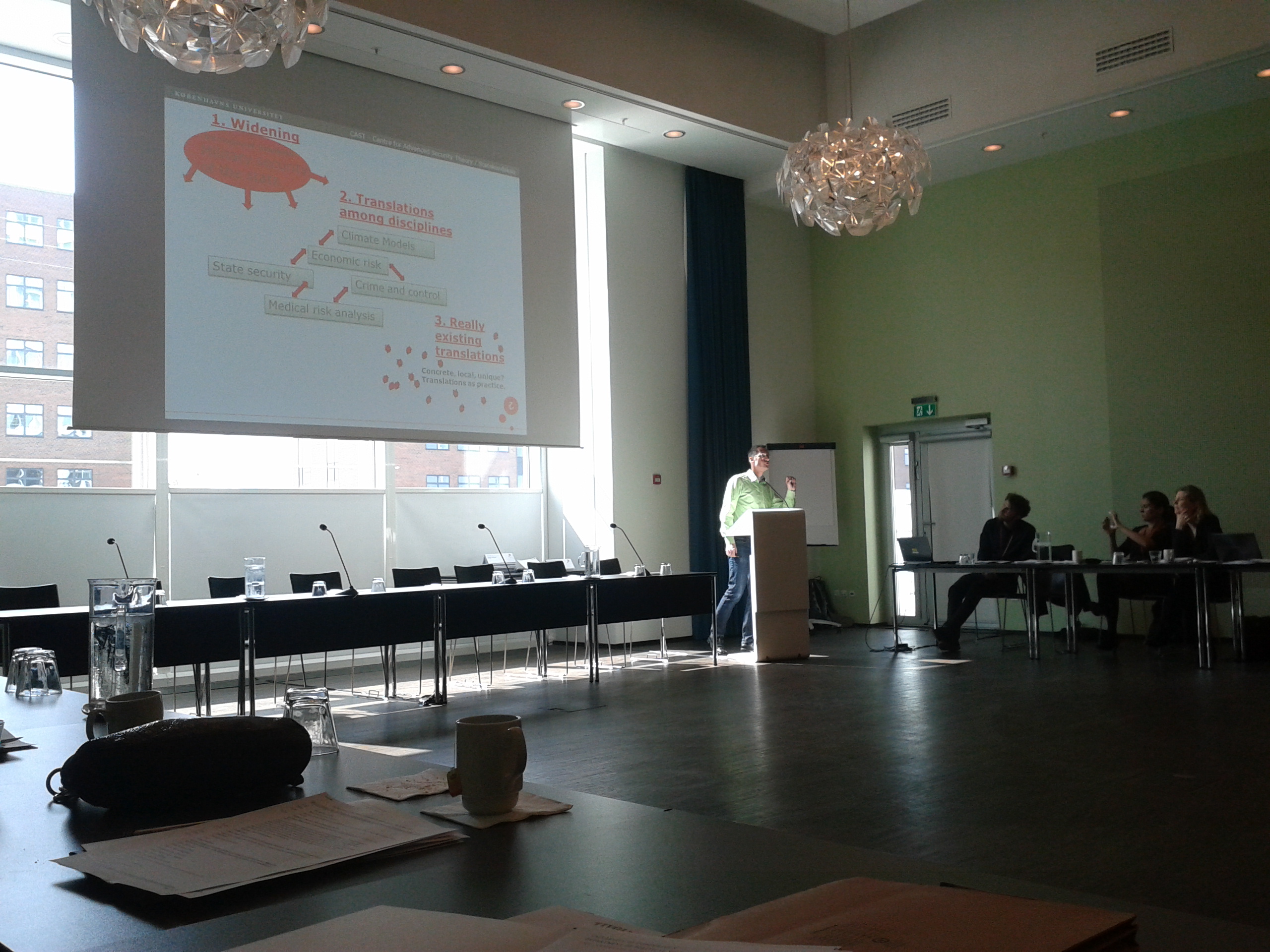
Ole Waever discussing the evolution of security theory at CAST conference
The conference will take ‘new security studies’ beyond the established theoretical debates and schools and ask questions to translation of security across disciplines and in practice. In theoretical and empirical terms it will address how meetings between different fields of practice continually challenge, modify or maintain social understandings of security threats, risks and dangers.
At the conference we will thereby attempt to think security beyond securitizations and not focus on how different sectors or fields increasingly incorporate one specific security logic (securitization). Instead, this conference will draw attention to how different spheres, organizations, and cultures manage threats and what happens when objects or issues move among and across these.
In the Field: Contact Group Meeting in New York
 From May 14th to 17th I am attending the counter-piracy week of the Contact Group on Piracy off the Coast of Somalia (CGPCS). I primarily attend as a participant observer to further record and study the working practice of the CGPCS, its plenary and its working groups. During the week the reform of the group’s structure and the future of counter-piracy will be discussed. At a side event after the plenary meeting the initial results of the lessons learnt project of the CGPCS (see llp.piracy-studies.org) will be introduced and discussed. I will give a presentation in which I will present some initial findings with regards on the replicability of the CGPCS experience in other contexts.
US State Department Official visits to discuss Lessons Learned on Maritime Piracy
Yesterday, we had the pleasure to welcome Donna Hopkins in Cardiff. Mrs. Hopkins is the maritime security coordinator of the U.S. State Department and former Chairman of the Contact Group on Piracy off the Coast of Somalia (CGPCS). She was visiting the university to discuss the first outcomes of our Lessons Learned Project. Cardiff University joined an international consortium of leading research institutions in November 2013 commissioned by the CGPCS to capture its experience, draw lessons of its work and ask how its success story can be replicated. The CGPCS is the main global governance vehicle driving the concerted efforts by the international community to curb piracy off the coast of Somalia. Somali piracy has threatened international trade and commerce and seafarers since 2007. The CGPCS was founded in 2008 following up on a Security Council resolution to address this challenge. If hundreds of ships were attacked between 2008 and 2012, and over one thousand seafarers held hostage for ransom, since 2012 no piracy attack was successful. The CGPCS is behind the tremendous success of the international community in containing piracy. The Lessons Learned project is capturing this success story and in a two year effort attempts to analyse it in order to draw lessons for other core challenges of global governance. Throughout the day we discussed some of these lessons with Mrs. Hopkins and the students of my MSc piracy seminar had the opportunity to meet and discuss their research projects with her.
Worlding Beyond the West Book Series
Together with Inanna Hamati-Ataya from Aberystwyth University I am joining the editorial board of the Worlding Beyond the West Book Series published by Routledge and the Taylor & Francis Group. The WBW series was initiated in 2008 by Arlene B. Tickner and Ole Waever to provide intellectual space for books which explore the role of geocultural factors in setting the concepts and epistemologies through which IR knowledge is produced. In particular, it seeks to identify alternatives for thinking about the “international” that are more in tune with local concerns and traditions outside the West and to put the disciplinary practices and structures of IR under empirical scrutiny. The series has published five books so far. From its first volume all are pioneering contributions to the discussion on non-Western IR and showcase innovative research in the sociology of the discipline of IR.
- (2014) Border Thinking on the Edges of the West. Crossing Over the Hellespont, By Andrew Davison
- (2013) Claiming the International. Edited by Arlene B. Tickner & David L. Blaney
- (2013) International Relations in France. Writing between Discipline and State. By Henrik Breitenbauch
- (2012) Thinking International Relations Differently. Edited by Arlene B. Tickner & David L. Blaney
- (2009) International Relations Scholarship Around the World. Edited by Arlene B. Tickner & Ole Wæver
The series will be jointly edited by Arlene B. Tickner, David Blaney, Inanna Hamati-Ataya, Ole Waever, and me. Together we will further strengthen the series profile and success in publishing benchmark contributions in the fields of post-colonial IR, reflexive IR, the sociology of science and knowledge production in world politics which will provide answers to how we generate knowledge and thereby make the World.
PhD Course on the Methodology of Interviewing in Politics

Home of the Department of Politics and International Relations
On April 9th, 14:00-18:00, I am teaching together with Ian Stafford a PhD training course on different methodologies of interviews. The course provides an advanced introduction to the methodology of interviewing in a political science context. Along with text analysis, interviewing is perhaps the most widespread qualitative method used in political science and international relations. Interviewing is however not only one of the most complicated and resource intensive methods, but also requires a high degree of methodological reflexivity. In this short course we discuss the core problems of planning, conducting and interpreting interviews as well as writing with interview data. The course is suitable for PhD Researchers in Political Science and International Relations in all stages of their research. In the course we discuss the following issues: Continue reading
Roundtable on Ocean Governance @ Cardiff University
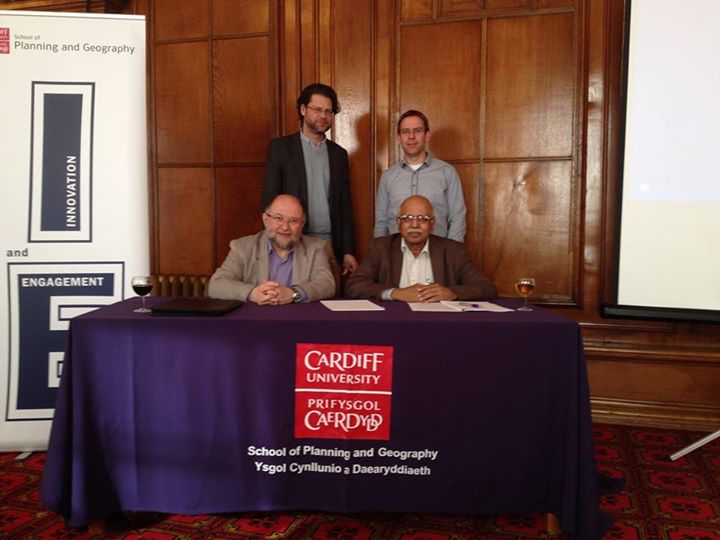 On April 8th we will discuss questions of maritime security and ocean governance in a roundtable on “How can the oceans be governed?” at Cardiff University. The roundtable brings together a range of scholars from Cardiff University from different disciplines working on maritime issues. The roundtable is a further step in strengthening cross-disciplinary collaboration in the field of maritime research. Further information is available here. In my own presentation I will discuss how the new maritime security agenda changes our understanding of the oceans and how they will be governed in the light of the UK’s upcoming maritime security strategy. I argue that what is going on here is quite a substantial if not radical revaluation of the meaning of the sea and an entirely new attempt to govern the oceans. The security logic is creeping into one of the last domains that was untouched from it before. The sea is becoming securitized. If you are an optimist this will imply that more attention will be paid to what happens at sea and the oceans as a social and environmental space will be better off. If you are a pessimist that will imply new forms of control and new sources of disputes and violence, and potential of escalation.
Conference on Future Challenges of Maritime Security
Maritime Security is a complex, interconnected challenge and addressing it requires close cooperation and coordination among different agencies, including the navies. On April 1st and 2nd I participated in a conference organized by the Naval Staff Strategy Unit and the Global Directions program of Merton College Oxford which aimed at discussing how to rise to these challenges. The conference drew together a range of participants from think tanks, universities, NGO’s, IO’s and navies to ask which strategies can be developed for navies in a maritime security environment. In the conference different regional theaters, including the Gulf, the Mediterranean, or the Gulf of Guinea were discussed as well as the broad range of maritime security issues, stretching from illegal migration and fisheries crime to piracy and climate change were debated. In my own contribution I drew on a recent article published in African Security to ask how a maritime strategy can be build around the task of the facilitation of maritime security communities. Building maritime security communities is a viable end for maritime security strategy. Two core challenges however arise, firstly, the problem of overlap and regime complexity, and, secondly, how to ensure ownership and and organic growth of security communities.
International Studies Association Conference in Toronto

From March 25th to 29th I will be participating in the 55th Annual Conference of the International Studies Association. I am part of five panels. On Wednesday Felix Bethke and me present our new paper on the sociology of IR, which presents a bibliometric analysis of fashion trends in IR. Our Panel “WC13: IR Going Places: Empirical Investigations of a Dividing Discipline” has an exciting range of papers discussing quantitative approaches to the sociology of the discipline. In “WD10: Critical Security Studies Methods Cafe”, we draw on the great experience from last year and discuss methodologies and methods for the study of security. Together with Vincent Pouliot I’ll be running the table on practice approaches. On Friday I participate in the Roundtable “FB06: Assemblages and International Theory”. We discuss the outcomes of the new edited volume on Assemblages (Re-Assembling International Theory. Assemblage Thinking and International Relations, edited by Michele Acuto and Simon Curtis, Palgrave MacMillan). On Saturday I am part of two panels. In the Panel “SB07: “Be Kind, Rewind”: ANT, Pragmatic Sociology, and Innovative Frameworks for IR” I will present my recent work on Piracy and Problematization theory. Finally, I will be the discussant for the Panel “SC44: Knowledge in International Relations” which discusses different approaches to Knowledge and Epistemic Practices in IR.
Presentation on Practice Theory and Piracy at CEU
On March 5th I will give a presentation on how knowledge about piracy is produced in the UN system at the Central European University in Budapest. I use the case of piracy to argue for more attention to researching how the practice of international knowledge generation. Further information on the talk and the paper that it relies on is available here. This is the abstract of the paper:
How are international phenomenon rendered knowable? By which means and practical devices is international knowledge generated? In this article I draw on the case of contemporary maritime piracy to introduce a research framework that allows addressing these questions. Arguing that the practices of international knowledge generation are weakly understood I show how concepts from science and technology studies provide us with the tools to study these practices empirically. Relying on the practice theory of Karin Knorr Cetina, I introduce the concepts of epistemic infrastructures, epistemic practice, and laboratories and demonstrate how they spur interesting insights on knowledge generation. I investigate three ‘archetypes’ of epistemic practices in detail and show how these generate knowledge about piracy for the United Nations: the quantification practices of the International Maritime Organization, the interpretation work of a Monitoring Group and the net-work of a Special Adviser. The article introduces an innovative agenda for studying knowledge generation in international relations by focusing on the practical epistemic infrastructures that maintain knowledge about international phenomena.