Christian Bueger


A moment of relief: What’s next for the Strait of Hormuz?

The decision by the United States not to further escalate its conflict with Iran, alongside a two-week ceasefire, has offered the global economy a brief moment of relief. Both sides have declared victory. Yet as details of the agreement slowly emerge—and remain subject to further negotiation—it is clear that the outlook for global trade is mixed.

A temporary arrangement has been reached for the Strait of Hormuz, one of the central arteries of the global economy. This narrow waterway is critical not only for energy flows but also for the food security of billions. What happens here reverberates far beyond the region.

Since the onset of hostilities involving the United States and Israel, Iran has exercised tight control over navigation through the strait. It has threatened to target vessels linked to its adversaries while guaranteeing safe passage to only a limited number of ships, primarily those transporting Iranian oil to Asia. In practice, the strait has been neither fully closed nor fully open.

The ceasefire appears to ease immediate tensions. Iran is expected to lift its direct threats against commercial shipping. However, it will retain significant control over access. Rather than restoring full freedom of navigation, the emerging “new normal” places decisions over passage largely at Iran’s discretion.

Tehran has also indicated its intention to impose transit fees as a means of compensation for the war. While international law does not permit direct charges for passage, it does allow fees for services rendered (see UNCLOS para. 26). This legal grey area could provide Iran with substantial leverage. Much will depend on the details—particularly the criteria used to determine which vessels are allowed to transit and under what conditions. For now, those rules remain opaque.

A process at the International Maritime Organization will likely be required to puzzle out the details and offer the industry reassurance. How this impacts the risk assessments of the shipping industry remains to be seen. Many shippers are likely to pause their transits and wait to see how the situation develops.

Higher transit costs, increased insurance premiums, and persistent uncertainty will likely raise the price of shipping. Countries heavily dependent on this route will bear the burden, effectively absorbing part of the economic cost of the conflict and essentially paying for Trump’s war.

Diplomatically, the ceasefire marks a success for regional actors, notably Pakistan, which acted as the facilitator, backed by its partners Egypt, Turkiye and Saud Arabia – increasingly known as the Muslim Quad. We are likely to hear more from this new grouping and its strategy not only in the Gulf but also in the broader Indian Ocean.

At the same time, we are facing a moment that underscores the weakening of the multilateral system. The UN Security Council met only hours before the ceasefire was agreed to vote on a resolution that would have implied a broader global agreement for the Strait of Hormuz.

It would have provided the foundation for a multilateral mechanism, such as a contact group, that could provide safety in the Strait in the long run. China and Russia used their veto. The failure to adopt a broader agreement highlights growing geopolitical fragmentation. Yet, a Security Council resolution is not fully off the table. After this failure, restarting negotiations will require some time.

The result is not a return to normality, but the emergence of a more politicized and fragile maritime environment—one in which chokepoints are increasingly weaponized and politically controlled. Freedom of navigation will become more and more limited.

Upcoming UN Security Council resolution on Strait of Hormuz

The first UN Security Council resolution (2817) on the current situation in the Strait of Hormuz was historic: 135 states sponsored the document calling for an end to attacks on shipping. Ten days of intense negotiations later, the Council is expected to vote on a follow-up resolution today.

According to the Security Council Report, the resolution calls on states “to coordinate efforts, defensive in nature, commensurate to the circumstances, to contribute to ensuring the safety and security of navigation across the Strait of Hormuz, including through the escort of merchant and commercial vessels, and to deter attempts to close, obstruct, or otherwise interfere with international navigation”.

That means that the Council will not explicitly authorize the use of force, as some states called for. Its focus on defensive measures is useful, as it does not risk escalation.

The resolution will serve as a solid foundation for a future arrangement for governing the strait, which can be put in place once a ceasefire is agreed. This will be led by the 40-nation-plus coalition of states that have already agreed to contribute to the protection of shipping in the region.

A contact group will likely be the best format to organize the coalition, to enhance military coordination, coordination with the shipping industry, and to harmonize legal understandings.

As I have argued in a recent commentary for EUobserver, the EU could play a leading role, given its experience with organizing multilateral naval operations, and the strong information-sharing infrastructure it has in place.

All of this only can be activated once hostilities end. It’s important to have solid planning already now.


Media roundup – situation in Strait of Hormuz

Transit through one of the global economy’s most central water way – the Strait of Hormuz – continues to be limited. Since the war started on 28th of February, only few ships have gone through the Strait. These were either directly linked to Iran, or countries negotiated individual passages with the government. The economic impact has been globally felt and the crisis effects small island states and least developed countries in the most dramatic way.

Over the past days, I have spoken to different media to help publics to understand better why it is difficult to return to normal traffic in the Strait. The strait cannot just be opened but require a multi-stage process. Diplomatic solutions are key to develop a governance arrangement that can provide some level of physical protection for shipping and reassurance. A UN mandate would be crucial to ensure impartiality and legitimacy. Highlights include conversations with Neue Zürcher Zeitung, Wall Street Journal, and France24. See the full overview here.


How can maritime flows return in the Strait of Hormuz? New commentary

The Strait of Hormuz is vital for the global economy, the longer it stays closed the higher the risks. Yet, returning to normal will be difficult.

In my most recent commentary, published with Global Observatory, I look at mid-term scenarios. A UN Security Council mandate, or even a maritime UN Peacekeeping mission, could be key. Leadership from the EU will be needed.

Read here: https://theglobalobservatory.org/2026/03/strait-of-hormuz-time-for-a-maritime-peacekeeping-operation/


Strategic Foresight Diplomacy in Action – The EU-Indonesia dialogue.

It was a pleasure to contribute to an innovative EU-Indonesia track 1.5 dialogue this week.

Track 1.5 dialogues are a conventional tool in diplomacy. In Southeast Asia they are even one of the main modes of diplomatic negotiations – known as the ‘ASEAN way’. Mixing participants from ministries of foreign affairs, governmental research organizations and independent think tanks, their primarily objective is usually trust and confidence building, developing interpersonal networks, but also epistemic alignments: open exchanges on problem interpretation, current and planned policies, recent developments and plans. Chatham house rules are usually applied and participants are asked to make frank remarks or ask critical questions, which could otherwise violate diplomatic conventions. If and how such events are effective and trickle down to formal track 1.0 diplomatic negotiations is often debated, but in the end very difficult to measure.

This week I participated in the EU-Indonesia track 1.5 dialogue. Mainly concerned about the implications of the recent comprehensive trade treaty, the event was noteworthy as the EU tried out a new format: strategic foresight. In what might be described as “foresight diplomacy”, the focus of the event was on exchanges on foresight expertise.


Strategic foresight is a planning approach that has become increasingly popular in the defense sector, economic policy making, but also the commercial sector. As a methodology it is focused on the management of risk by identifying mega trends and scenarios. Contrary to forecasting, multiple futures are anticipated and evaluated for their plausibility in participative processes. The goal of planning is preparedness and resilience. Both the OECD and NATO have developed important guidelines for carrying out such analyses and the EU and Indonesia, but also many others, have developed foresight capacities in their diplomatic services.

Foresight diplomacy is focused on the systematic exchange not only of experience, but also the outcomes of foresight exercises. Comparisons between meta trends, scenarios and resulting gaps and planning priorities serve as the basis for not only epistemic alignment, but also identifying common interests and collective action space.

According to the organizers the event that I attended was one of the first in which the EU, led by the foresight unit in the European External Action Service and its partner – Forward Global –, tested this approach. While there’s a risk that foresight diplomacy dialogues become methods driven and technocratic, they might be extremely useful to overcome the short-termism and news focus that too often prevails at track 1.5 dialogues. I look forward to following how the EU continues to advance this innovative form of diplomacy.


Joining forces with the Charles Telfair Centre in Mauritius

Professional news: I have joined the Mauritius based Charles Telfair Centre as an Associate Fellow from February this year. The Center is one of the leading cross-cutting think tanks in the Western Indian Ocean working on the challenges of Small Island Developing States and regional governance issues.

In my role, I will support the center’s ambitions in the area of regional ocean governance and maritime security. We will focus in particular on how maritime security governance structures in the region can be strengthened, persistent blue crimes and safety risks can be encountered, and increasing geopolitical risks can be mitigated. One focus area will also be the future governance of the Chagos archipelago. We also hope to form relevant expert networks within and beyond the region.

Do not hesitate to get in touch if you want to discuss opportunities for collaboration.


Looking back at 2025

Time for a brief look back at 2025. Here is what made this year special:

  1. Playing Tejo, an ancient throwing game and the national sport of Colombia, in Bogota with Andres Julian Trujillo Rosero after an intense strategic foresight event with the Colombian Navy.
  2. Wandering the streets of New York in the early mornings after a non-stop flight from Singapore, staying awake to be fresh for my briefing at the UN Security Council’s high-level debate on maritime security.
  3. Receiving a crystal ball as a gift in Singapore, which significantly improved my approach to strategic foresight.
  4. Meeting the pink pigeon, Mauritius’ national endangered bird, in one of the national parks while conducting research on maritime security in the Western Indian Ocean.
  5. Seeing our edited volume on global ocean regions in print completing an amazing intellectual journey with Elizabeth Mendenhall, Bec Strating and others.
  6. Recognizing how many varieties of tuna dishes one can make while visiting The Maldives National University, thanks to Athaulla (‘Atho’) Rasheed.
  7. Launching my new newsletter ‘Turbulent Seas’, although fewer issues were published in 2025 than originally envisioned. Watch that space!
  8. Enjoying the Abu Dhabi sunset while sipping a cold brew with Brendon J. Cannon after a presentation at TRENDS Research & Advisory.
  9. Seeing my first article published in French, though this would not have been possible without great translators at Diplomatie.
  10. Visiting the Taj Mahal ahead of the National Maritime Foundation- NMF’s Indo-Pacific Regional Dialogue.
  11. Recognizing that I have given close to 60 talks in 2025, including briefings to the European Council, the European Parliament, and NATO’s Operation Policy Committee. 2026 will be focused on writing!

To everyone I had the privilege of meeting in 2025: thank you for making it extraordinary. Excited to see what 2026 brings…


Talk at Oslo Maritime Security Seminar

Yesterday, I attended the 20th Oslo Maritime Security Seminar – the Nordic’s major industry event on the topic.

With more than 300 attendees, highlights included discussions on grey zone strategies, the shadow fleet, and the challenges linked to growing incidents of GNSS spoofing and jamming. I was invited to discuss the state of maritime security governance and presented six observations. Here in brief:

  • The agenda is evolving rapidly—from terrorism to piracy to smuggling to today’s grey zone threats (cyber, infrastructure attacks, state provocations).
  • Maritime security is now multidimensional—we’re thinking beyond surface and include subsea infrastructure, space, and cyber. That’s creating new governance complexities.
  • A new wave of privatization is underway, driven by robotics, new sensors, AI and data fusion. It’s democratizing maritime domain awareness but also creating new dependencies.
  • There’s a “coastguard revolution”—navies are stepping back from constabulary work, coastguards are stepping up, and this has major implications for maritime investment.
  • Regional cooperation is intensifying as neighbors work closer together. But so is the risk of fragmented regional governance.
  • The UN is gaining real momentum on maritime security—three high-level meetings this year, 120+ states in agreement.

You can read the script of my intervention here.

A personal highlight: Taking the stage at a comedy club – the venue of the seminar – clearly opened new career ideas.


Visit to Indian maritime security center

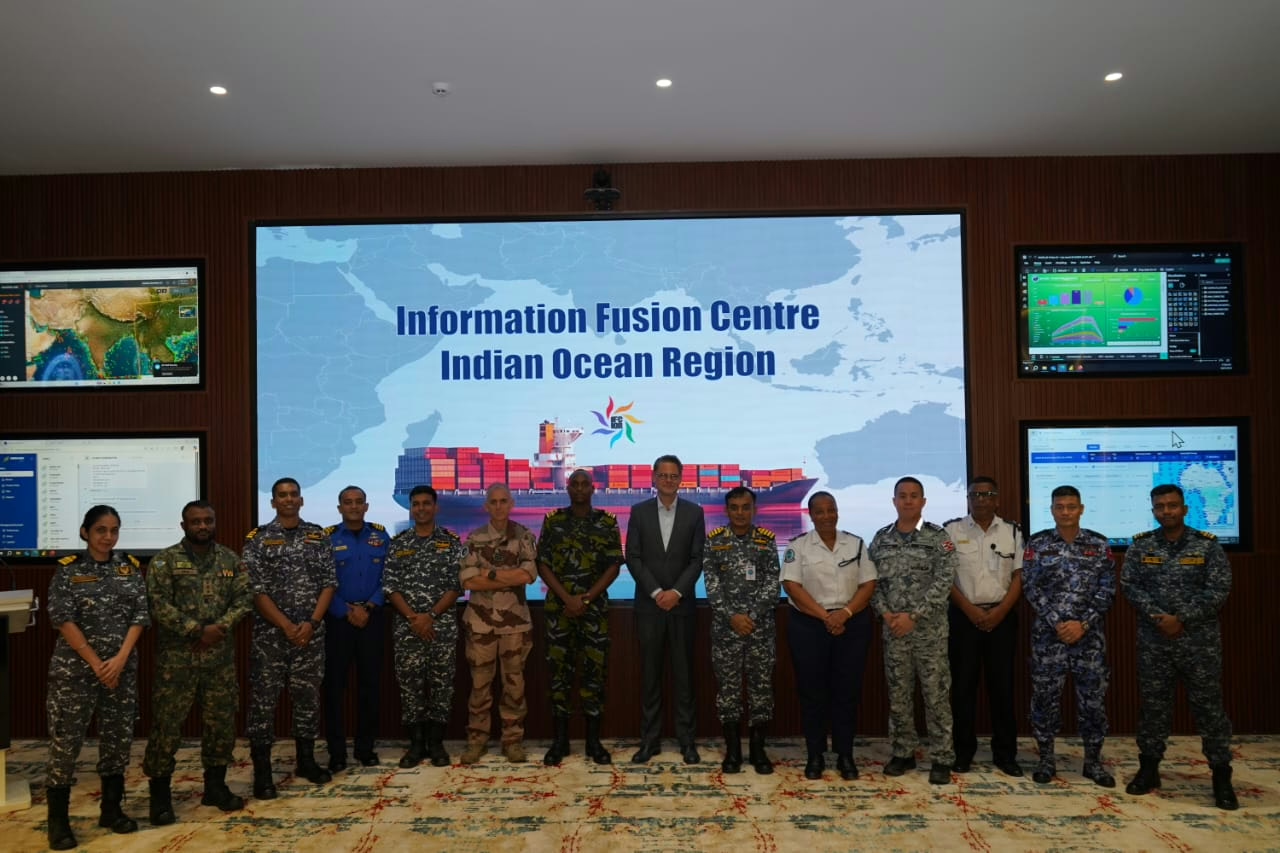
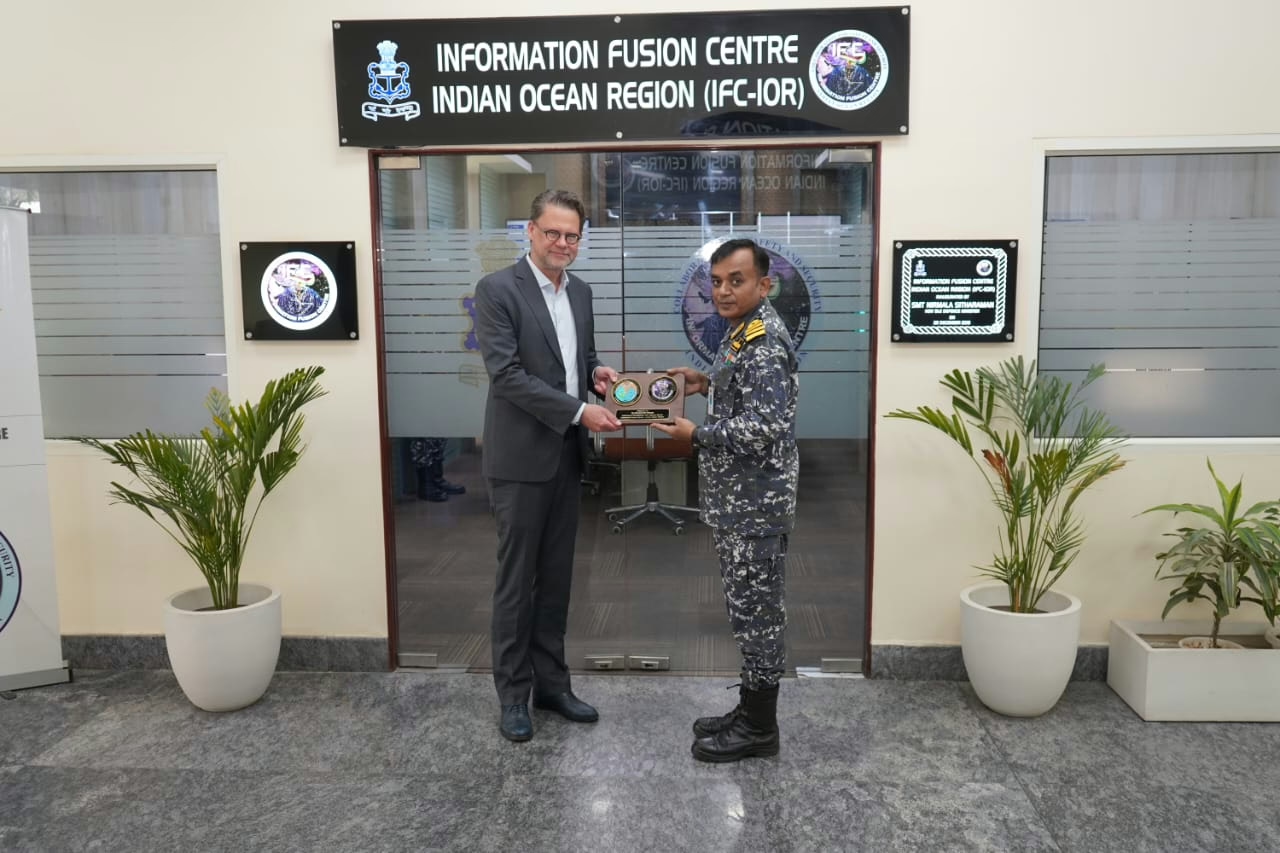
Continuing my tour of the world’s leading maritime domain awareness centers, I had the pleasure of visiting the Information Fusion Center – Indian Ocean Region (IFC-IOR) last week. The center is an initiative by the Indian Navy to improve information sharing and understanding of maritime security dynamics.

IFC-IOR is modeled after the Singapore Navy’s Information Fusion Center. It is staffed by Indian Navy personnel as well as International Liaison Officers from the Indian Ocean region from currently 15 countries. Closely linked to India’s national maritime fusion center (IMAC), the IFC-IOR’s backbone is an information fusion platform named ‘Mantra’.

Overall, the center performs four main functions:

  • It provides reports on maritime security incidents at regular intervals to provide accurate information on patterns of maritime security threats with a focus on the Indian Ocean region as well as the Gulf of Guinea.
  • The center provides support to regional maritime operations by the Indian Navy, including incidents of piracy or search and rescue missions.
  • It engages in regional capacity building activities and training through workshops on maritime domain awareness and information sharing.
  • Confidence building and naval diplomacy through building relations with international and regional maritime security forces is another major task.

In acting as a regional maritime information clearinghouse, high-level reporting is currently the IFC-IOR’s strongest contribution to the regional maritime security architecture.

Like other centers and platforms, the IFC-IOR faces the challenges of how to better integrate with other initiatives, including the four centers that form SHADE’s Single Information Framework. Another challenge lies in how to automate work, and move from information sharing to enhancing operations through prediction.

In regional terms, the center will also need to strengthen its role in supporting coordinated regional maritime security operations, including those led by its neighbors or organized in the framework of the Regional Maritime Security Architecture.


Coast guard gathering in Rome

What challenges are the cost guards of the world facing? This week I had the pleasure to participate in the largest global gathering of coast guards in Rome to find out.

As I discussed in my recent edition of ‘Turbulent Seas’, coast guards are becoming more and more important in maritime security.

The Rome gathering, organized by the Italian Coast Guard, comprised of back-to back meetings of the Mediterranean, European and Global Coast Guard forums, brought more than 100 delegations to the city. The gathering, which included in person remarks by Giorgia Meloni and the Secretary General of the International Maritime Organization, was a useful indicator for the key issues currently on the agenda:

  • Artificial Intelligence and Technology Integration: There was a strong emphasis across all three events on leveraging AI, unmanned systems, big data analytics, and emerging technologies to enhance maritime domain awareness, search and rescue operations, and predictive security capabilities.
  • International Cooperation and Information Sharing: Discussions prioritized collaborative approaches to maritime challenges, featuring extensive partnerships between coast guards, EU agencies (EMSA, EFCA, FRONTEX), and international organizations for shared training, capacity building, and data exchange.
  • Climate and Environmental Focus: Significant attention was given to ocean health, climate change impacts, decarbonization of shipping, alternative fuel sources, and environmental enforcement, reflecting the maritime sector’s adaptation to sustainability challenges.

Ensuring that coast guards exchange lessons and promising practices in dealing with these challenges is vital. I look forward to continue observing how international coast guard cooperation unfolds and hopefully some of our upcoming research can be useful. India will host the next Global Coast Guard Summit in 2027.