Christian Bueger


A moment of relief: What’s next for the Strait of Hormuz?

The decision by the United States not to further escalate its conflict with Iran, alongside a two-week ceasefire, has offered the global economy a brief moment of relief. Both sides have declared victory. Yet as details of the agreement slowly emerge—and remain subject to further negotiation—it is clear that the outlook for global trade is mixed.

A temporary arrangement has been reached for the Strait of Hormuz, one of the central arteries of the global economy. This narrow waterway is critical not only for energy flows but also for the food security of billions. What happens here reverberates far beyond the region.

Since the onset of hostilities involving the United States and Israel, Iran has exercised tight control over navigation through the strait. It has threatened to target vessels linked to its adversaries while guaranteeing safe passage to only a limited number of ships, primarily those transporting Iranian oil to Asia. In practice, the strait has been neither fully closed nor fully open.

The ceasefire appears to ease immediate tensions. Iran is expected to lift its direct threats against commercial shipping. However, it will retain significant control over access. Rather than restoring full freedom of navigation, the emerging “new normal” places decisions over passage largely at Iran’s discretion.

Tehran has also indicated its intention to impose transit fees as a means of compensation for the war. While international law does not permit direct charges for passage, it does allow fees for services rendered (see UNCLOS para. 26). This legal grey area could provide Iran with substantial leverage. Much will depend on the details—particularly the criteria used to determine which vessels are allowed to transit and under what conditions. For now, those rules remain opaque.

A process at the International Maritime Organization will likely be required to puzzle out the details and offer the industry reassurance. How this impacts the risk assessments of the shipping industry remains to be seen. Many shippers are likely to pause their transits and wait to see how the situation develops.

Higher transit costs, increased insurance premiums, and persistent uncertainty will likely raise the price of shipping. Countries heavily dependent on this route will bear the burden, effectively absorbing part of the economic cost of the conflict and essentially paying for Trump’s war.

Diplomatically, the ceasefire marks a success for regional actors, notably Pakistan, which acted as the facilitator, backed by its partners Egypt, Turkiye and Saud Arabia – increasingly known as the Muslim Quad. We are likely to hear more from this new grouping and its strategy not only in the Gulf but also in the broader Indian Ocean.

At the same time, we are facing a moment that underscores the weakening of the multilateral system. The UN Security Council met only hours before the ceasefire was agreed to vote on a resolution that would have implied a broader global agreement for the Strait of Hormuz.

It would have provided the foundation for a multilateral mechanism, such as a contact group, that could provide safety in the Strait in the long run. China and Russia used their veto. The failure to adopt a broader agreement highlights growing geopolitical fragmentation. Yet, a Security Council resolution is not fully off the table. After this failure, restarting negotiations will require some time.

The result is not a return to normality, but the emergence of a more politicized and fragile maritime environment—one in which chokepoints are increasingly weaponized and politically controlled. Freedom of navigation will become more and more limited.


Upcoming UN Security Council resolution on Strait of Hormuz

The first UN Security Council resolution (2817) on the current situation in the Strait of Hormuz was historic: 135 states sponsored the document calling for an end to attacks on shipping. Ten days of intense negotiations later, the Council is expected to vote on a follow-up resolution today.

According to the Security Council Report, the resolution calls on states “to coordinate efforts, defensive in nature, commensurate to the circumstances, to contribute to ensuring the safety and security of navigation across the Strait of Hormuz, including through the escort of merchant and commercial vessels, and to deter attempts to close, obstruct, or otherwise interfere with international navigation”.

That means that the Council will not explicitly authorize the use of force, as some states called for. Its focus on defensive measures is useful, as it does not risk escalation.

The resolution will serve as a solid foundation for a future arrangement for governing the strait, which can be put in place once a ceasefire is agreed. This will be led by the 40-nation-plus coalition of states that have already agreed to contribute to the protection of shipping in the region.

A contact group will likely be the best format to organize the coalition, to enhance military coordination, coordination with the shipping industry, and to harmonize legal understandings.

As I have argued in a recent commentary for EUobserver, the EU could play a leading role, given its experience with organizing multilateral naval operations, and the strong information-sharing infrastructure it has in place.

All of this only can be activated once hostilities end. It’s important to have solid planning already now.


Media roundup – situation in Strait of Hormuz

Transit through one of the global economy’s most central water way – the Strait of Hormuz – continues to be limited. Since the war started on 28th of February, only few ships have gone through the Strait. These were either directly linked to Iran, or countries negotiated individual passages with the government. The economic impact has been globally felt and the crisis effects small island states and least developed countries in the most dramatic way.

Over the past days, I have spoken to different media to help publics to understand better why it is difficult to return to normal traffic in the Strait. The strait cannot just be opened but require a multi-stage process. Diplomatic solutions are key to develop a governance arrangement that can provide some level of physical protection for shipping and reassurance. A UN mandate would be crucial to ensure impartiality and legitimacy. Highlights include conversations with Neue Zürcher Zeitung, Wall Street Journal, and France24. See the full overview here.


Maritime security futures for the UN – Discussions in New York

 Back from maritime security discussions in New York. Some key observations:

The situation in the Persian Gulf is unsurprisingly dominating the agenda at the UN. The historic consensus around Security Council Resolution 2817, co-sponsored by no less than 136 countries, documents that the UN and the Security Council have to play a major role in resolving the war.

Bringing shipping back to the Strait of Hormuz is a top priority, but will be tricky. The Secretary-General’s new initiative to establish a humanitarian mechanism for shipping fertilizer is a beacon of hope. It could be a starting point for restoring trust and confidence and provide the seeds for a more sustainable arrangement.

Planning for post-conflict scenarios for the Strait of Hormuz is under way. Several scenarios are discussed at high levels. The first UN maritime peace operation is one option on the table. All of this can only start once a ceasefire is in place.

Importantly, the current crisis feeds the momentum that the UN system requires a more sustained and strategic approach to maritime security. The strong consensus to act became visible during the two high-level debates last year. Delighted to learn that Bahrain will drive the debate forward during its April presidency.

I had the pleasure of briefing the UN Task Force on Security Sector Reform on how UN-level maritime security work can be better coordinated. For the task force, the sea is one of its eight priorities. Small steps so far, but very important and promising. I hope we will see more from the taskforce.

Thanks to the delegations that took time out from their busy schedules to meet me. Special thanks to Thomas Tödtling and Christophe Pradier for their leadership in pushing forward the agenda.

Looking forward to visiting the city again soon to feed in ideas for this important debate.


How can maritime flows return in the Strait of Hormuz? New commentary

The Strait of Hormuz is vital for the global economy, the longer it stays closed the higher the risks. Yet, returning to normal will be difficult.

In my most recent commentary, published with Global Observatory, I look at mid-term scenarios. A UN Security Council mandate, or even a maritime UN Peacekeeping mission, could be key. Leadership from the EU will be needed.

Read here: https://theglobalobservatory.org/2026/03/strait-of-hormuz-time-for-a-maritime-peacekeeping-operation/


New journal article: What happens at naval symposia?

In a new article published with the ISA journal Global Studies Quarterly, I investigate international naval symposia. Starting out from the observation that these forms of multi-national military gatherings are proliferating, I show what happens at these events and why it matters.

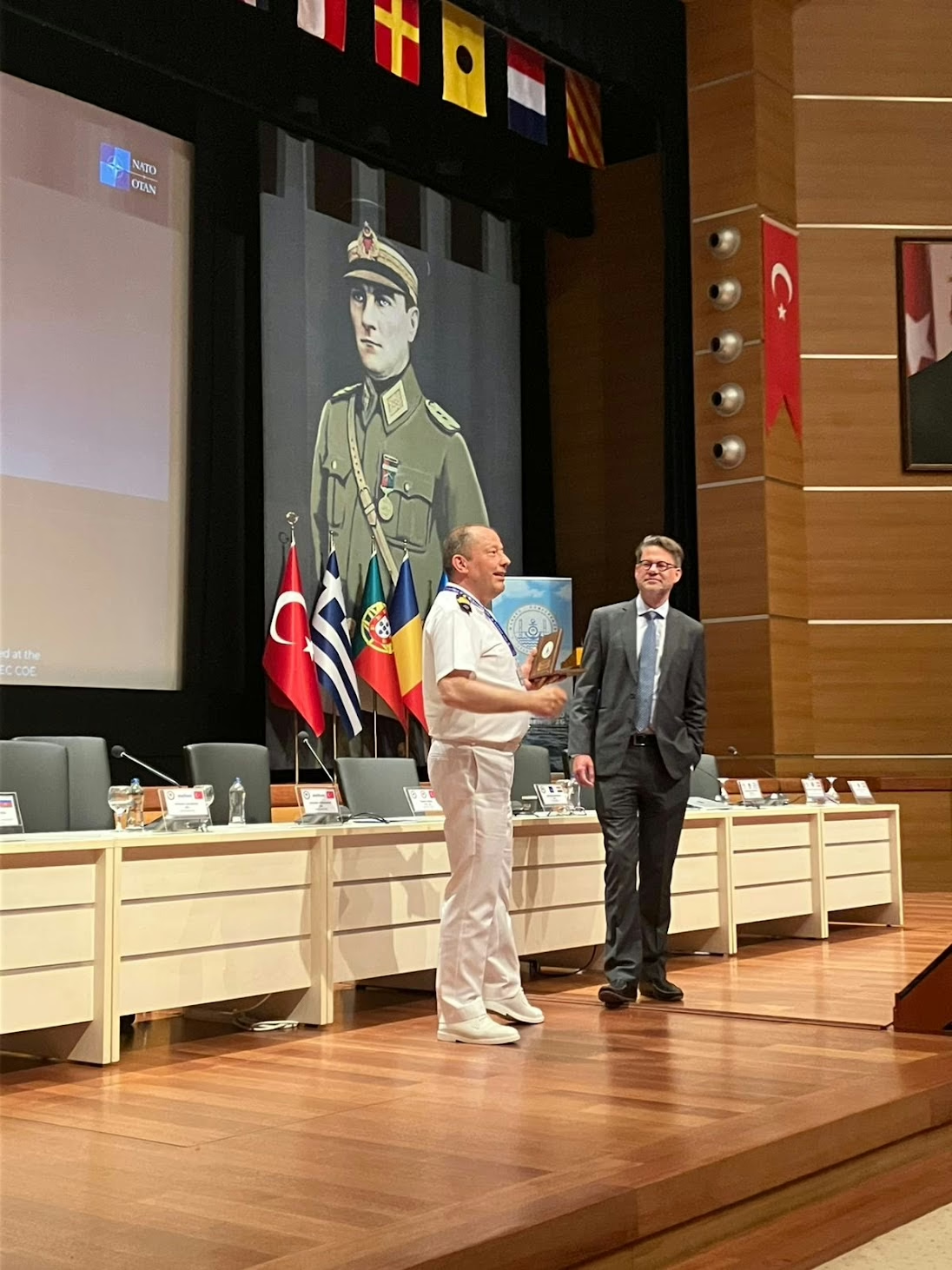
Trying to combine my work as a maritime security expert with the spirit of an ethnographic observer, I draw on my experience of participating in 15 naval symposia around the world. My argument is that these events are sites of ritualized practices and share common elements, such as gift exchanges, which create social bonds among military leaders.


Maritime security in Southeast Asia: Celebrating the 20th anniversary of ReCAAP

Southeast Asia has long been a region of maritime security innovation. A key driver was the maritime piracy crisis in the late 2000s.

A key regional governance mechanism originating from that time is the Regional Cooperation Agreement on Combating Piracy and Armed Robbery against Ships in Asia (ReCAAP) and its associated Information Sharing Centre (ISC). ReCAAP is one of the few legally binding and well institutionalized regional maritime security frameworks that has served as a role model for arrangements such as the Djibouti Code of Conduct in the Western Indian Ocean and the Yaoundé Code of Conduct in the Gulf of Guinea.

On Friday, 13.3., I had the pleasure to participate in the symposium celebrating the 20th anniversary of ReCAAP as a panel moderator. This provided a great opportunity to revisit a comprehensive study on maritime domain awareness in Southeast Asia that I conducted in 2015. Most of the observations continue to be valid:

ReCAAP’s main function is to provide a clearing house for piracy-related information and to analyze available incident data. It’s key strength is to ensure high level of awareness and understanding of piracy in the region, even if threat levels are low. The centre’s work is moreover important in capacity building and the exchange of lessons across global ocean regions.